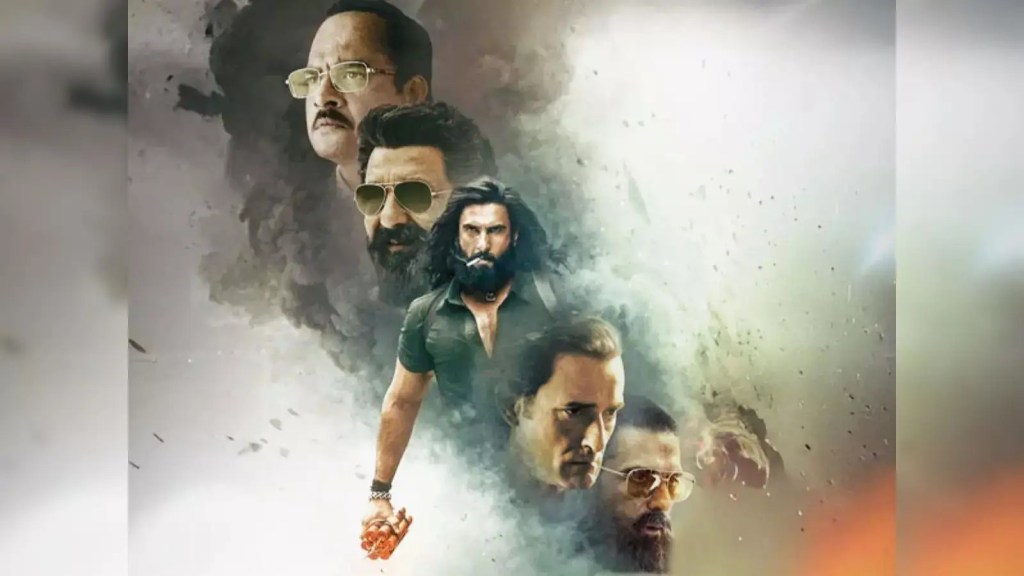
Category: Film Review | Genre: Spy Thriller | Language: Hindi
Watched Dhurandhar yesterday, and I needed to sit with it for a full day before I could even begin to articulate what I felt. This is not just another Bollywood spy movie—it is a deeply unsettling, emotionally exhausting, and ultimately cathartic experience.
The premise of the film is now well known—a story of covert intelligence operations to identify and neutralise terrorists. Indian cinema (and Hollywood too, truth be told) has mostly portrayed spies as stylish figures in sharp suits, backed by thumping background scores, glamorous introductions, and impossible stunts.
The first film that truly captured the terror and existential danger of being an undercover agent for me was The Departed (2006). Leonardo DiCaprio’s William “Billy” Costigan Jr. remains etched in my memory—especially that scene where he almost gets caught. The narrow escape, followed by his visceral reaction, translated the horror of living on the edge in a way no stylised spy film ever had. It stayed with me for years after I watched it. I never rewatched the film—not because I didn’t love it, but because I couldn’t.
That’s precisely what has always been missing in most stylised spy movies: the fear of being caught. That fear is routinely overshadowed by glamorous escapades, conveniently stupid antagonists, and plot holes the size of moon craters—like ISI protecting Indian agents for the sake of India’s sovereignty.
Dhurandhar Takes a Completely Different Path
It takes the existing Bollywood spy universe and spins it on its axis.
The film does not glamourise the spy world. Instead, it lays bare the time it takes to infiltrate terror camps, the dangers of deep cover, the horror of watching your actions hurt your own country while remaining a mute spectator because this is a long game, and the sheer moral rot within terror groups when political power enters the picture.
Aditya Dhar’s research shows in every frame. His script is tight, his direction assured. There wasn’t a single scene I felt could be cut. In fact, I didn’t even realise I’d spent 3.5 hours in a theatre. What a cathartic experience.
Performances That Elevate Dhurandhar
Ranveer as Jaskirat/Hamza: Living on the Edge of Exposure
Ranveer Singh as Jaskirat / Hamza is phenomenal. The patience with which he waits for months just to get a foot into the dreaded world of Rahman Baloch/Dakait, and then waits again to earn his place as the right-hand man, is portrayed with remarkable restraint. Every choice he makes chips away at him as a patriot, yet strengthens his resolve to see the mission through—Savdhaan and Sabr, drilled into him by his mentor. An effortless, controlled performance.
(Also—on a lighter note—his hair. Almost a character in itself.)
Madhavan as Ajay Sanyal: Authority Without Noise
Madhavan as Ajay Sanyal is introduced with stunning authority. I genuinely couldn’t believe it was Madhavan on screen. He completely inhabits the body language and gravitas of a stalwart intelligence officer. Yes, some dialogues may sound propagandist to some, but it’s important to note that his criticism extends to the NDA government of 1999–2004 as well. He sees the coalition government of that time as lacking conviction, bowing to political pressures while over 200 lives hung in the balance.
India was seen as weak internationally for a very long time. That is a reality no one can deny. We bowed to American and European pressure, never understanding that a bully stops only when punched back—at least once. Ajay Sanyal understood this, and that understanding gave birth to Operation Dhurandhar. His repeated reminder—Savdhaan aur Sabr—has proven, in hindsight, to be the country’s most effective long-term strategy.
What the film also does, without sermonising, is acknowledge the terrible cost of decisions taken at the time. While that particular call did end up saving those lives in the moment, it also set in motion events that culminated in the 2001 Parliament attack, leading to the deaths of nine of our soldiers and countrymen. In barely thirty seconds, Dhar humanises the people guarding our Parliament—small, everyday moments before the shootout begins. When the woman officer is killed, the horror seeps quietly into our conscience. The job may be a choice, and the danger too—but death is never chosen.
The Antagonists: Violence Without Romance
There is not one wasted casting choice. Everyone on the opposing side is portrayed as their truly disgusting, horrific selves. Even when they lose someone, I felt nothing. They chose violence. They willingly picked up guns to kill their own people and innocent civilians across borders.
Watching Baloch groups align with ISI for political power—handing over weapons to the very organisation that has systematically killed Balochis for resisting Pakistani domination—was deeply distressing. Rahman Baloch lying effortlessly to his own people, promising futures for children who would ultimately become victims of the same forces, was chilling. For them, it is always about money and power.
Arjun Rampal as Major Iqbal Lyari: The Face of Psychological Terror
Arjun Rampal revels in being hated—and it shows. As ISI militant leader Major Iqbal Lyari, he is terrifying. The slow drawl, the sickening smile, the venom in his words, and the torture scene are genuinely hard to sit through. The horror of being caught isn’t just dawning on Hamza—it hits the audience full force.
Akshaye Khanna: A Masterclass in Controlled Villainy
And then there is Akshaye Khanna—both the phenomenon and the revelation.
When he debuted in the late ’90s, his charm was infectious. He looked every inch a future superstar. Yet despite his talent, versatility, and even a few blockbusters, superstardom eluded him. I believe it came down to two things: he never chased stardom, and his premature hair loss—along with his refusal to artificially mask it early on. Ironically, that turned out to be his greatest blessing.
As Rahman Baloch, Akshaye delivers one of the most controlled, chilling portrayals of a truly vile human being. The way he walks, kills, commands fear, and even looks at people made my skin crawl. He is never shown as an idiot—not even in the final chapter, when he realises what Hamza is planning.
Why Dhurandhar Matters
I don’t know how to fully convey what I felt watching this film. I do know one thing—I am a coward. I would never send my child into something like this. And yet, countless parents and spouses in this country do exactly that. Dhurandhar made me feel the weight of that sacrifice throughout.
These unsung heroes are our children—living daily with the threat of torture and death so that we can sleep peacefully. Calling out this reality is not hatred; it is acknowledgement. This film is not about Indian Muslims—it is about the brutal truth of espionage and the sacrifices of those who protect the nation.
My heart is with them. I pray for nothing but their victory and safe return. And as a citizen, I will continue to call out hypocrisy—whether it comes from the left or the right.
Bharat Mata Ki Jai.
If you enjoy grounded, realistic spy thrillers that focus on psychological cost rather than glamour, Dhurandhar deserves to be watched—and discussed.
Footnote: I did have a couple of issues. The casting of Sara Arjun—yes, the age gap is explained within the story — still felt awkward for me. The discomfort stems less from the narrative and more from the real-life contrast: he is in his 40s, while she is barely in her twenties, and that dissonance never fully went away. The bike chase sequence was another moment that stretched credibility too far; the entire police force in pursuit crossed into excess. Thankfully, these were minor blemishes in an otherwise tightly written and deeply affecting film.
 The Curated Corner
Leave a comment